Is Windows Defender Enough, According to Reddit
By Unes (@unespc) · · 7 min read
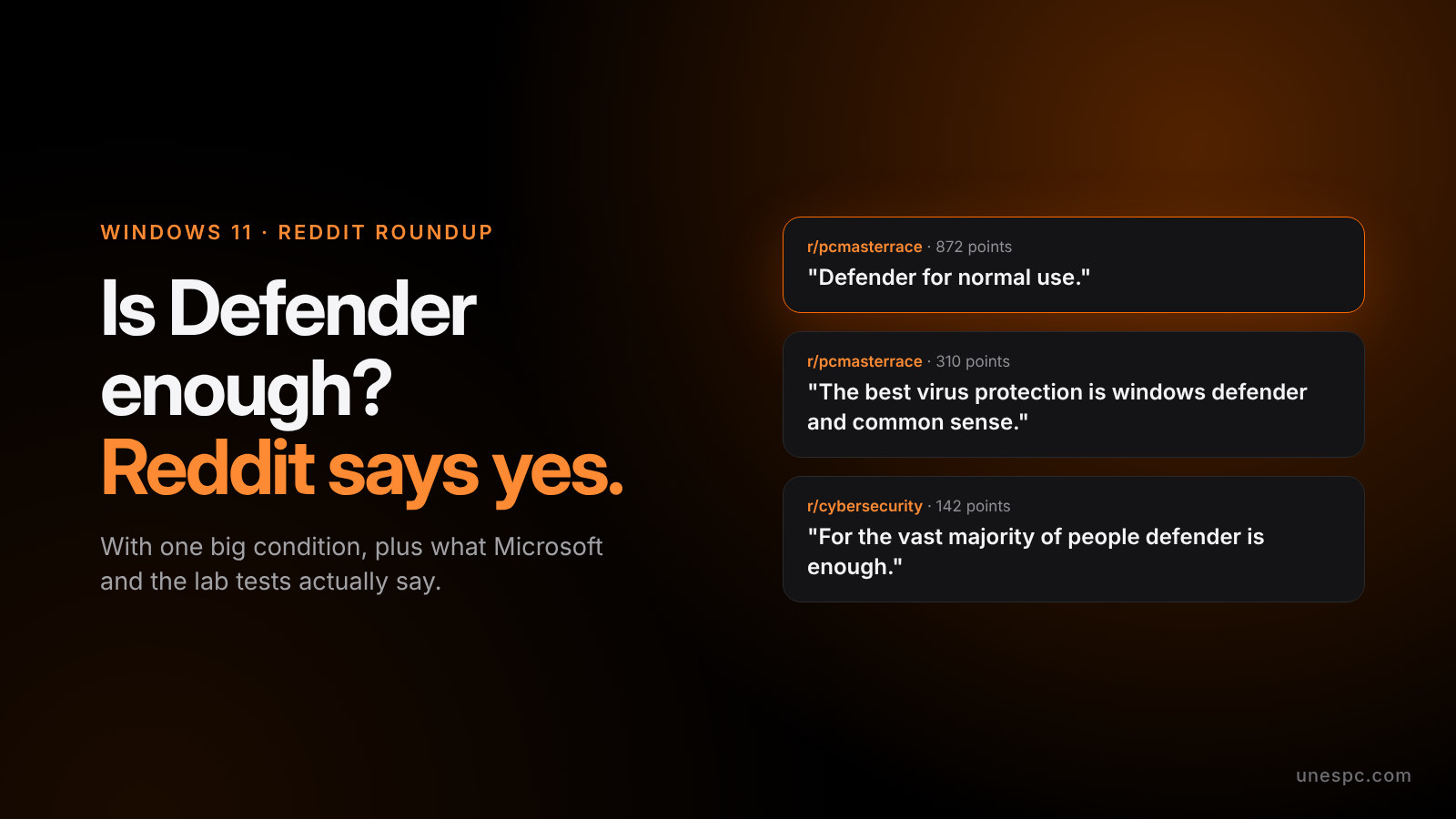
Ask Reddit "is Windows Defender enough" and the answer is basically yes. Across every thread I read, the most upvoted replies say the antivirus built into Windows 10 and 11 is all most people need, as long as you also use common sense about what you download and click. The most common extras are an occasional manual scan with the free version of Malwarebytes and an ad blocker, not a paid antivirus suite.
And this time Microsoft, independent lab tests and Reddit all mostly agree, which honestly almost never happens.
What does Reddit say about Windows Defender?
The consensus is loud. In an r/pcmasterrace thread from April, the top reply (872 points) sums up Reddit's whole stance in one line: "Defender for normal use." That same comment says Malwarebytes is for removing malware that's already on your PC.
It's not just one thread either:
- In a June 2026 r/pcmasterrace thread from someone new to PC gaming, the top reply (310 points) is "The best virus protection is windows defender and common sense."
- In r/cybersecurity, the top comment (142 points) says Defender is enough for the vast majority of people, and even plenty for businesses running Microsoft's enterprise version of it.
- An older r/pcmasterrace thread has a 570 point reply recommending Defender, a monthly Malwarebytes scan, and common sense.
- In r/techsupport, a 13 point reply puts it bluntly: "it's not the year 2005."
What does Reddit actually recommend?
Here's how the advice breaks down across the threads.
| Setup | What Redditors like | Reddit's catch |
|---|---|---|
| Defender on its own | Free, built in, no extra bloat | Only as good as your habits |
| Defender plus Malwarebytes Free | A second opinion scan when something feels off | Run it as a manual scan, don't stack it as a second real-time antivirus |
| Defender plus an ad blocker | Blocks sketchy ads and fake download buttons | uBlock Origin works differently on Chrome now (more below) |
| A paid third-party antivirus | Extras like identity monitoring or family features | Most replies call it unnecessary for normal home use |
The Malwarebytes part matters, because a lot of people get it wrong. Malwarebytes' own help center comparison shows Quick Scan and Custom Scan are free on Windows, while Real-Time Protection is paid. So the free version is a cleanup tool you run yourself, which is exactly how Reddit uses it.
Why does Reddit hate paid antivirus like Norton and McAfee?
Mostly because people think it's bloat that does the same job Defender already does. In a September 2026 r/pcmasterrace thread, one reply with 16 points calls extra antivirus "just bloatware doing basically the same thing, and slowing down your system." In an r/Windows11 thread where someone asked about antivirus for a new laptop, the top reply is just "Short answer: no," and a couple of others specifically steer them away from Norton.
That's opinion, not lab data. But there's a real technical reason not to stack security apps, and it comes straight from Microsoft (next section).
Did Microsoft really say you don't need antivirus?
Kind of, and the story is messier than the headlines.
Microsoft's antivirus FAQ says its security software protects you against malware, spyware and adware, and that "you don't need to install any other real-time antivirus or antispyware software." The same page recommends against running other antivirus products at the same time as Defender, because more than one real-time security product can affect your PC's performance. On-demand scanners are fine, since they only run when you ask them to.
Then in April, PCWorld and TechRadar covered a Windows Learning Center post saying that "for many Windows 11 users, Microsoft Defender Antivirus covers everyday risk without requiring additional software." That's the post Reddit was arguing about.
Here's the part almost nobody mentions. According to Windows Central, that April article was later taken down, which AV-Comparatives spotted. Microsoft's January post, Trusted antivirus protection for PCs, is still up and makes a softer version of the same point: Defender is built in, needs no subscription, and gives solid real-time protection.
What do independent lab tests say about Defender?
They back Reddit up. On AV-TEST's Microsoft results page, Microsoft Defender Antivirus (Consumer) scored 6 out of 6 for protection in every test from December 2025 through August 2026:
| AV-TEST round | Protection | Performance | Usability |
|---|---|---|---|
| December 2025 | 6 | 6 | 6 |
| February 2026 | 6 | 6 | 6 |
| April 2026 | 6 | 6 | 6 |
| June 2026 | 6 | 5.5 | 6 |
| August 2026 | 6 | 5.5 | 6 |
So the protection is top tier. The only dip is a half point on performance in the two latest rounds, which is AV-TEST's score for how much a product slows down the PC.
When is Windows Defender not enough?
This is where Reddit isn't fully unanimous, and the dissent is worth reading.
In that 872 point r/pcmasterrace thread, a 106 point reply pushes back on the "Defender and common sense" line, arguing that common sense matters less when malware spreads through hijacked versions of legit software. In r/antivirus, a reply points out that no antivirus stops you from installing and running malware yourself, which is the real risk for people who pirate software or fall for scams.
Microsoft lists its own exceptions too. Per Windows Central, it said you might consider extra security software if you manage multiple devices, share devices with family, or want services like identity monitoring or parental controls. And its January post admits antivirus in general can't fully protect you from scams that trick you into handing over info, or from brand new ransomware and zero-day attacks.
One adjacent thing the threads skip: a lot of replies say "just get uBlock Origin," but on Chrome that's not so simple anymore. The uBlock Origin developer's wiki explains that the full extension is built on Manifest V2, which Chrome has deprecated, and that uBlock Origin Lite is the Manifest V3 version with fewer features. Chrome won't swap it in for you, so you have to pick the replacement yourself.
How do I check that Windows Defender is actually on?
Worth doing, especially if an old antivirus trial expired on your PC. One r/techsupport reply says exactly that: make sure the expired tool is uninstalled and Defender is active. Here's how, using Microsoft's Windows Security guide.
On your PC:
- Open the Start menu and search for Windows Security, then open it.
- Select Virus & threat protection.
- Select Manage settings under Virus & threat protection settings.
- Make sure Real-time protection is set to On.
- Go back and select Quick scan if you want to check your PC right now.
If you'd rather not click around, I built FixKon, and its free Security page reads what Windows Defender already knows and shows which protections are turned off, with one-click fixes to turn them back on. It works with your antivirus, it doesn't replace it.
If you're ditching a third-party antivirus, uninstall it properly, then check your startup list while you're at it. I covered how in my guide to stopping apps opening at startup.
So is Windows Defender enough? My take
Reddit's right on this one, and the lab data is on its side. Defender scoring 6 out of 6 for protection in every AV-TEST round this year is hard to argue with, and paying for a suite that mostly duplicates it is a waste for a normal home PC. And no shot I'm running two real-time antiviruses at once when Microsoft itself says that can affect performance.
Where Reddit falls short is the "common sense" part. It's good advice, but it's doing a lot of heavy lifting. The 106 point reply has a point: when malware hides inside legit-looking downloads, common sense alone won't save you. So my version is Defender, a real ad blocker, Windows updates turned on, and the free Malwarebytes scan when something feels off. If you pirate stuff or share your PC with family, that's when paying for extras starts to make sense.
What are you running right now, just Defender or something extra?
FAQ
Is Windows Defender enough for Windows 11?
For most home users, yes. Reddit's top replies, Microsoft's own antivirus FAQ, and AV-TEST's 2026 protection scores all point the same way, as long as you keep Windows updated and are careful with downloads.
Should I use Malwarebytes with Windows Defender?
As a manual scanner, sure. The free version of Malwarebytes only does manual scans, and Microsoft says on-demand scanners are fine alongside Defender. Just don't run two real-time antivirus products at once.
Did Microsoft say you don't need third-party antivirus?
Its antivirus FAQ says you don't need to install other real-time antivirus software. An April 2026 Learning Center post went further, but Windows Central reported it was later taken down.
Is Windows Defender free?
Yes. Microsoft Defender Antivirus is built into Windows 10 and Windows 11, with no subscription.
I break down Windows security stuff in quick videos on Instagram and YouTube, and the Discord is where people compare setups. Want your PC handled for you? Get FixKon here, and if you're shopping for PC tools, check out what Reddit says about PC optimizers.