Banks Now Make You Liable for Your AI Agent's Mistakes
By Unes (@unespc) · · 6 min read
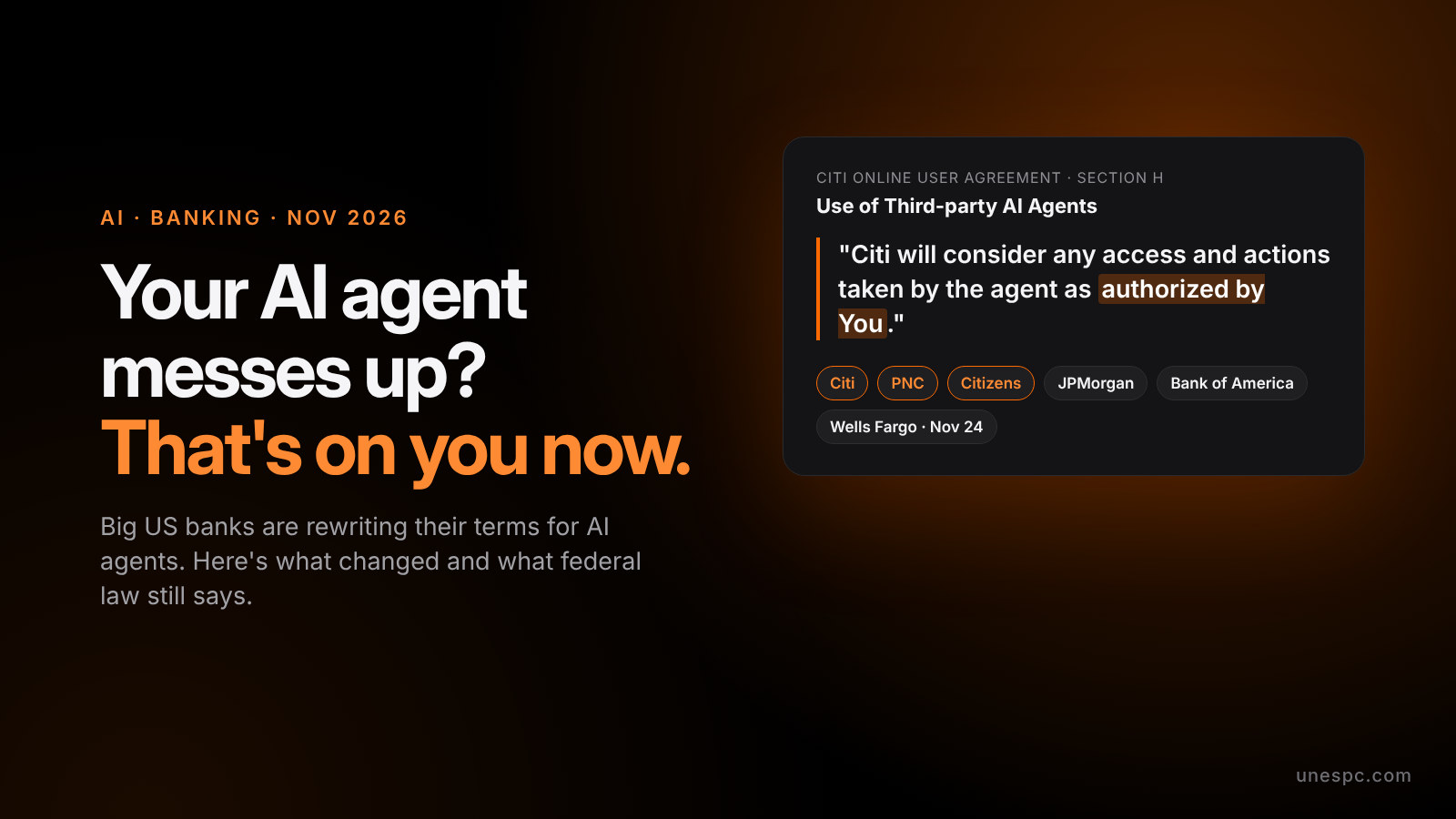
If you let an AI agent log into your bank account and it screws up, a growing list of big US banks now say that's your problem, not theirs. This week Citi, PNC and Citizens joined JPMorgan and Bank of America with new AI agent liability rules, according to TechCrunch, and Citi's version even covers the case where the AI tool gets hacked. Federal law still protects you from truly unauthorized transfers, but handing an agent your login makes that a lot murkier.
So if you've been tempted to let ChatGPT or some finance bot "just handle my bills," read this first.
What did the banks actually change?
Citi went first this week. Its Online User Agreement now has a new Section H called "Use of Third-party Artificial Intelligence ('AI') Agents," added in November 2026. It says customers "are cautioned against using any third-party AI Agent" to access their accounts.
And if you do it anyway, the key line is brutal: "Citi will consider any access and actions taken by the agent as authorized by You."
Here's what else is in there, straight from Citi's terms:
- If the login you gave the agent gets "shared, leaked, or otherwise distributed" to other people or AI agents, Citi treats whatever they do as authorized by you too.
- Citi says it has no obligation to investigate, even if the agent's actions conflict with what you told it to do.
- You're responsible for the agent misreading your instructions, doing things you didn't intend, or going beyond the authority you gave it, "except as otherwise permitted under applicable law."
- Citi's privacy notice doesn't cover the agent, and Citi can block any third-party agent at any time.
Then PNC changed its terms on November 18, and Citizens emailed customers with a similar warning, per TechCrunch. The same report says JPMorgan and Bank of America announced similar policies last month.
Which banks have AI agent liability rules now?
| Bank | What happened | Source |
|---|---|---|
| Citi | New Section H in its Online User Agreement, November 2026 | Citi |
| PNC | Changed its terms on November 18 | TechCrunch |
| Citizens | Emailed customers a warning this week | TechCrunch |
| JPMorgan and Bank of America | Announced similar policies in October | TechCrunch |
| Wells Fargo | Updated agreement takes effect November 24 | Wells Fargo |
| Ally | Emailed customers this month | Business Insider |
Wells Fargo's own update page says that starting November 24, requests you send through a third-party AI tool "may be treated as if they came directly from you," and that the bank can restrict or block certain AI tools.
Ally's email, quoted by Business Insider, is the most honest one: "AI can make mistakes, hallucinate, misunderstand your instructions, or follow them in ways you didn't intend, which could lead to significant loss."
Why are banks doing this?
The official reason is risk. A Citi spokesperson told TechCrunch the bank wants customers "to understand the risks associated with sharing banking credentials" with third-party AI tools. That's fair. Giving an AI your bank password is basically giving it the keys, and these agents absolutely do make mistakes.
But there's a business angle too, and TechCrunch points it out. Banks see AI agents as a competitive threat, since an agent that shops around for better rates or dodges fees could cost them money. And notice the exception: Citi's terms don't apply to AI tools Citi itself provides inside its app. So the message is kinda "don't use their AI, use ours."
Does federal law still protect you if the AI gets hacked?
This is the gap nobody's really answering, so here's what the actual rules say. I'm not a lawyer, so treat this as the basics, not legal advice.
The big one is Regulation E, the federal rule for electronic transfers. Under 12 CFR 1005.6, "no agreement between the consumer and an institution may impose greater liability on the consumer for an unauthorized transfer than the limits provided in Regulation E." So a bank can't just write its way out of federal protections with a new terms update.
And the CFPB's own electronic fund transfer FAQ gives a clear example: when a person-to-person payment is sent by a third party "that fraudulently obtained access" to your account, like with "login credentials stolen in a data breach," it counts as an unauthorized transfer.
Here's the catch though. Citi's terms say the bank will treat what your agent does as authorized by you, and that's exactly the line federal law draws: unauthorized transfers are protected, authorized ones mostly aren't. If an agent you set up makes a dumb payment, that's probably on you. If a hacker steals your login from the AI tool, you've got a much stronger case, but expect a fight. Citi's own terms say they apply "except as otherwise permitted under applicable law," which is the bank admitting federal law still wins.
Timing matters too. Under the same Regulation E section, if you report a lost or stolen access device within two business days of finding out, your liability is capped at $50, and it goes up from there the longer you wait.
How do I protect my bank account if I use AI tools?
You don't have to swear off AI. Just be smart about what you hand over.
- Don't give an AI agent your bank username and password. That's the exact thing Citi's terms warn against, and it's what makes everything count as "authorized by you."
- Use read-only tools for budgeting. TechCrunch notes Anthropic's new personal finance tool is billed as "read-only" and "can't move, manage, or invest your money." Analyzing your spending doesn't need payment access.
- If you already connected an agent, cut it off. Change your bank password, revoke the tool's access, and keep proof that you did. Wells Fargo's update page says its new agreement includes your responsibilities for managing a tool's access, so check your own bank's terms.
- Watch your statements and report anything weird fast. The two business day window in Regulation E is real money.
- Lock down the device too. An AI agent is only as safe as the PC it runs on, and I covered the basics in whether Windows Defender is enough.
My take
Honestly, the banks aren't wrong, they're just being shady about how they say it.
Handing an AI agent your login is a bad idea right now, and these terms make that crystal clear. Agents misread instructions all the time. But the "use our AI, not theirs" carve-out tells you this is also about control. If AI agents become how people manage money, banks want to own that, not OpenAI or anyone else.
The part I don't love is that most people will never read Section H. They'll connect an agent because it's convenient, something will go wrong, and they'll find out the hard way that the bank already wrote them off. Federal law still has your back for real hacks, but "I gave the bot my password" is a rough place to start a dispute from.
Would you ever let an AI agent touch your bank account?
FAQ
Am I liable if my AI agent makes a mistake with my bank account?
At banks like Citi, yes, per their updated terms. Citi treats actions by a third-party AI agent you gave access to as authorized by you, including errors and actions beyond what you asked for.
Which banks make customers liable for AI agents?
As of November 2026, Citi, PNC and Citizens, after JPMorgan and Bank of America did something similar in October. Wells Fargo's updated terms take effect November 24, and Ally has emailed customers a similar warning.
Does Regulation E protect me if my AI tool gets hacked?
It can. The CFPB has said a payment sent by someone who fraudulently got your login, like credentials stolen in a data breach, counts as unauthorized, and no bank agreement can increase your liability beyond Regulation E's limits. Report it fast.
Can I still use AI for budgeting?
Yes. Stick to read-only tools or exported statements, and don't give any AI tool your bank login or payment access.
I break down stories like this in quick videos on Instagram and YouTube, and the Discord is where people argue about which AI tools are actually worth trusting. And if your Windows PC is the weak link, that's what I built FixKon for. More posts on the blog.